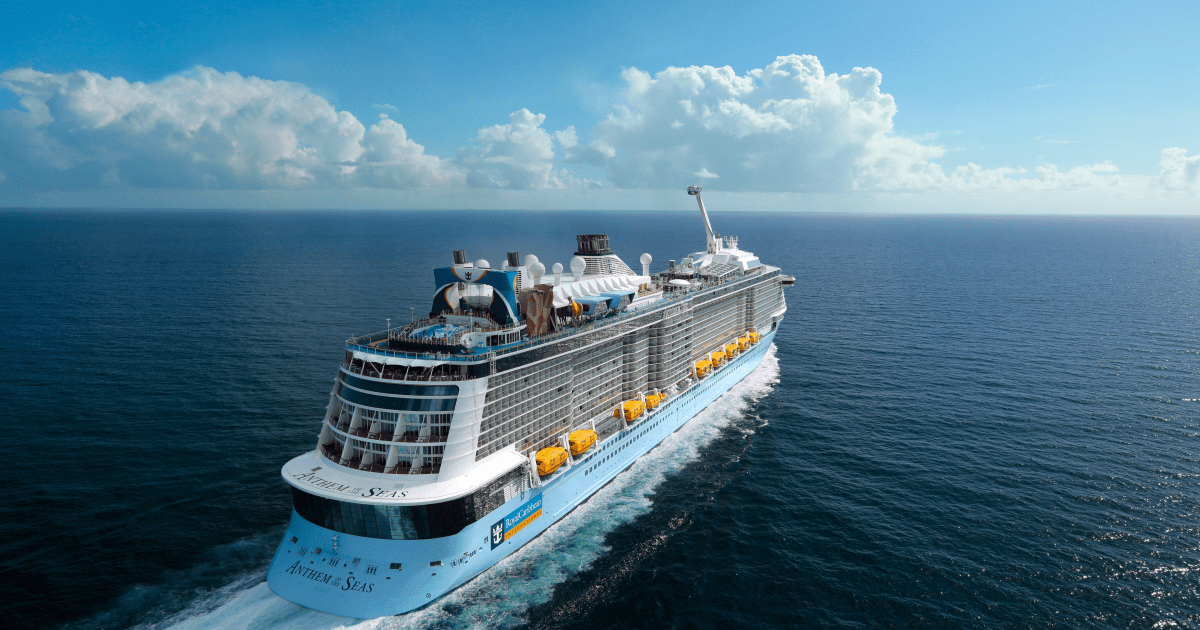
South Pacific Violations eight nights in the song Royal Caribbean’s Anthem of the Seas worth £ 739 per person.
Bang is appropriate for your money: The opportunity to explore the Paradise Islands while happy in the activities from direct performances to dinner All-You-can.
One thing you won’t get at that price? Room with a view.
Every explorer will know that if you choose a basic interior cabin, you sacrifice the opportunity to get natural light in your own room, without balcony, or even a window.
For some people, this is a fair agreement: the balcony space starts at £ 924, so you have to pay almost £ 200 extra just to feel the wind in your hair.
But Royal Caribbean has a compromise: virtual balcony.
Register to Newsletter Getaway
Lust wandering around the Bulletin offer of travel, guidelines, and inspiration that is cured. Register here.
For £ 858, guests can order rooms with high definition screens that ‘bring views of the sea directly to you’.
‘Windows’ even have fake curtains and fences, with direct feeds that are played whenever you want to see it.
First introduced in 2014, virtual balconies were considered a breakthrough at the time.
The shipping line works with experts at MIT and Harvard to design technology, who use a camera that is placed around the ship to bring bait directly to the room.
Now, there is a virtual balcony throughout the Royal Caribbean fleet, and that is included as a standard on the boards of several ships.
Genius or died limp?
This new unique feature attracts the attention of social media users, after the Tamara Wheeler influencer reviews his experience.

The video is flooded with comments – with users divided about what they think.
Some, many of them are experienced explorers, call it ‘genius ideas’.
‘This is amazing!’ Write on users on Facebook. “My last interior room, I will leave TV all night … just to wake up in the sun.”
But not everyone is so interested. “This is so artificial and dystopian,” wrote a tiktoker. Others call it ‘sad’ and ‘suffocating.’
Although the concept is not new, people may feel strong about it at this time, because we continue to adapt to the fast progress of AI and technology in everyday life – from the entertainment we consume to the way we eat.
Only this week, the virtual K-Pop band, Plave, was given the same protection under the defamation law such as a group of real life humans.
Elsewhere, Morrisons has become the newest supermarket announced the arrival of the AI trolley, which will allow customers to scan when shopping, weighing products, tracking them in real time, and even checking out.
Are you going to pay extra for virtual balconies?
‘A combination of real and virtual reality’
Virtual balcony is just the peak of the iceberg when it comes to how AI will affect how we explore the world.
We already know that futuristic technology affects the way we move.
For example, this new Dubai Airport launched their ‘red carpet corridor’ – a kind of passport tunnel that uses AI, biometric cameras, and flight data to recognize passengers, or suspicious luggage.
This means that travelers do not need to show a passport or boarding pass, and can delete the security process in just six seconds.
Dimitrios Buhalis, a professor in tourism and technology at Bournemouth University, said we tend to see the ‘mixed reality’ when technology develops.
“This is a combination of real and virtual reality,” he said Metro. ‘Virtual will complement physical experience.

‘For example, the destination, hotel chains, and shipping lanes can use a virtual reality experience before purchase, to give customers more information and more choices.
‘There is also a tour, which might use AI to show, for example, what acropolis in Greece really looks like thousands of years ago.
“The disadvantage is that AI is not always accurate.”
But can the virtual experience replace the authentic?
‘For some people, it will stimulate the interest and intention to visit certain places. The more realistic the photo, the more motivated by a traveler to leave. We will take more virtual trips, before we go to a place in real life, ‘said Professor Dimitrios.
He added: ‘For those who cannot travel – and there are many different reasons for this, from flying phobias, money, caring responsibility – these people will travel virtually rather than physically.’
Professor Dimitrios added that consumers will be ‘trained’ to expect more information before leaving.
‘We will be offered a better tool to compare and make choices. Traveler groups will be able to use information to make travel plans to match the preferences. Overall, AI will help us make more appropriate decisions when seeing the world. ‘
Do you have a story to share?
Contact by sending an email to [email protected].
More: I’ve been to Algarve 21 times – This is the way you can avoid the crowd
More: Tourists exceed the local population on the Greek island ‘networking’ named Most Crowded in Europe
More: Warrior Muay Thai English has many things to say about the Documentary Film Thailand ‘Stupid’ Zara Mcdermott
News
Berita
News Flash
Blog
Technology
Sports
Sport
Football
Tips
Finance
Berita Terkini
Berita Terbaru
Berita Kekinian
News
Berita Terkini
Olahraga
Pasang Internet Myrepublic
Jasa Import China
Jasa Import Door to Door

