The 2026 FIFA Fantasy World Cup has only just begun, but managers are already turning their attention to Round 2.
With several standout matches on the horizon, it is a good time to assess which countries offer the best potential heading into the new chapter.
To do this, we take a look at the new World Cup Fantasy Schedule Ticker.
WHO HAD THE BEST MATCH IN ROUND 2?
Let’s start at the top of the list with one of the most prominent matches of this round: Ecuador v Curaçao.
Sebastian Beccacece’s side are heavily favored to beat the minnows in this tournament, with a win probability of 84.6% according to our new World Cup Statistics Center.
They also have a 65% clean sheet chance, which is why many Fantasy managers are eager to include Hernan Galindez ($4.2 million), Willian Pacho ($4.4 million), or even cheaper, Joel Ordonez ($3.9 million), into their squad.
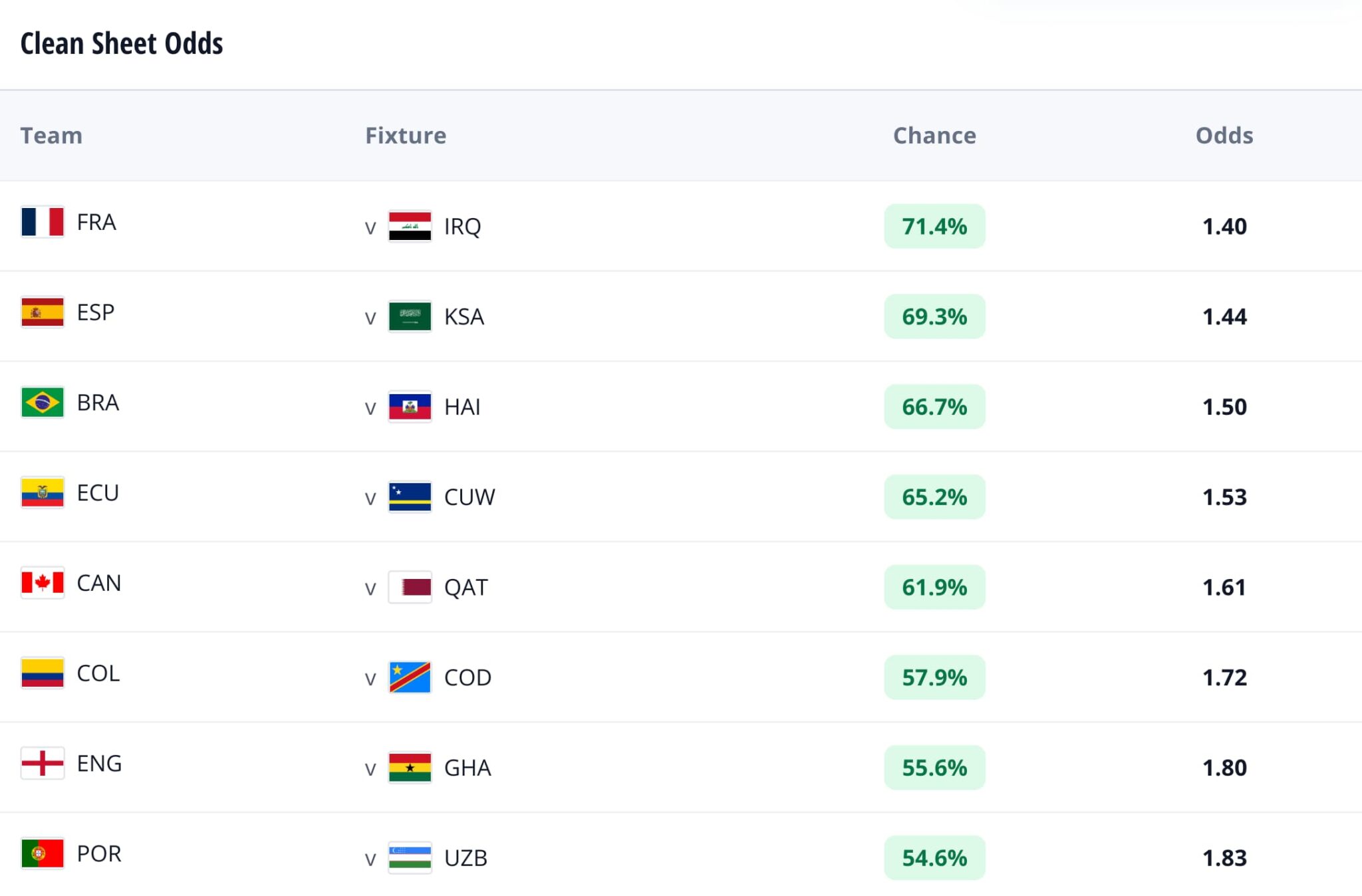
Fixture Ticker also likes Spanish And Brazil to do well.
It’s true, our Statistics Center gives both countries a 91%+ chance of coming out on top in their respective relationships against Saudi Arabia and Haiti.
Meanwhile, Uruguay And Switzerland both present potential in Round 2.
Uruguay will face Cape Verde, and given their pressure and intensity under Marcelo Bielsa, the likes of Federico Valverde ($7.5 million), Maxi Araujo ($6.4 million) and Darwin Nunez ($7.5 million) have the platform to make it happen.
Switzerland’s opponents, Bosnia and Herzegovina, beat Wales and Italy in European play-offs in March to qualify for the tournament. However, they failed to win either of their two World Cup warm-up matches against Panama and North Macedonia.
Considering South Africa barely posed a threat to Mexico in Thursday’s World Cup opener, with just three shots all game, you’d feel confident if you had Czech Vladimir Coufal ($3.6 million) or Ladislav Krejci ($4.4 million) in Round 2.
English (in Ghana), France (v Iraq), Belgium (v Iran) and Portugal (v Uzbekistan) also featured prominently, giving many Fantasy managers something to assess their match ahead of the upcoming deadline.
WHO HAD THE WORST MATCH IN ROUND 2?
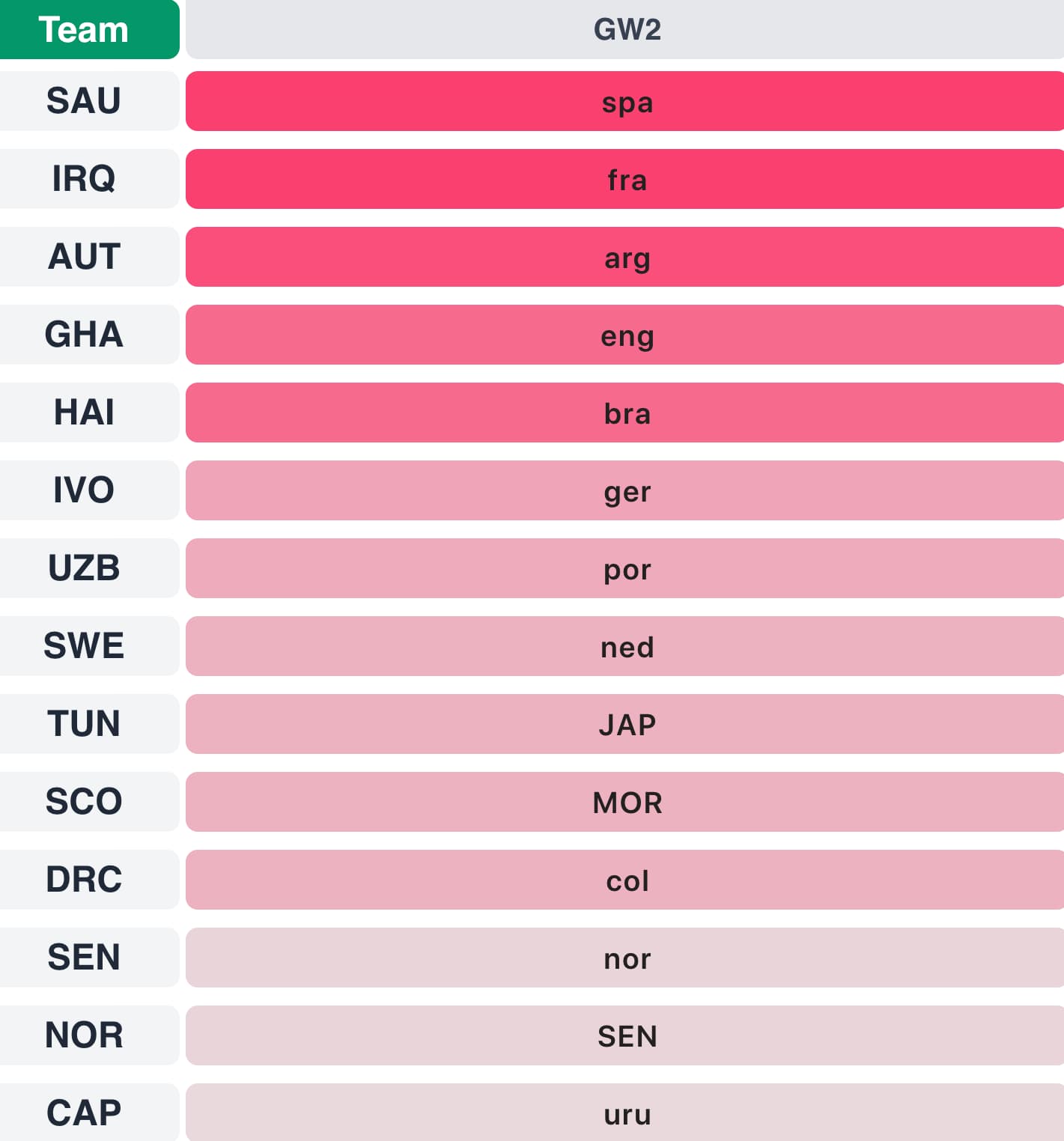
From countries that are more popular from a Fantasy perspective, Austria had one of the hardest ties in Round 2.
Ralf Rangnick’s side will face defending World Cup champions Argentina, so Marcel Sabitzer ($6.8 million) probably won’t be a ‘back’ for many of us after the match against Jordan.
Scott McTominay ($6.5 million) is a popular pick, at 10.6% of squads, however Scotland could be a team to avoid in Round 2.
Morocco are one of the contenders who could go strong in this tournament, and defensively, they remain a formidable team, having triumphed over Belgium, Spain and Portugal en route to the semifinals of the Qatar World Cup. They also ‘officially’ won the African Cup of Nations (AFCON) earlier this year.
Fantasy managers face a similar dilemma Norway assets, especially Erling Haaland ($10.5 million). According to our Statistics Center, Stale Solbakken’s team has a 47.4% win rate, compared to Senegal’s 30.3%.
But instead of focusing on the prospect of Norway/Haaland, it’s more about the appeal of some of the other strikers in Round 2, namely Vinicius Junior ($10.0 million), Kylian Mbappe ($10.5 million) and Harry Kane ($10.5 million). The prospect of fixtures for these players may tempt many managers to consider a premium switch.
WHO HAD THE BEST MATCHES IN ROUNDS 2 + 3?
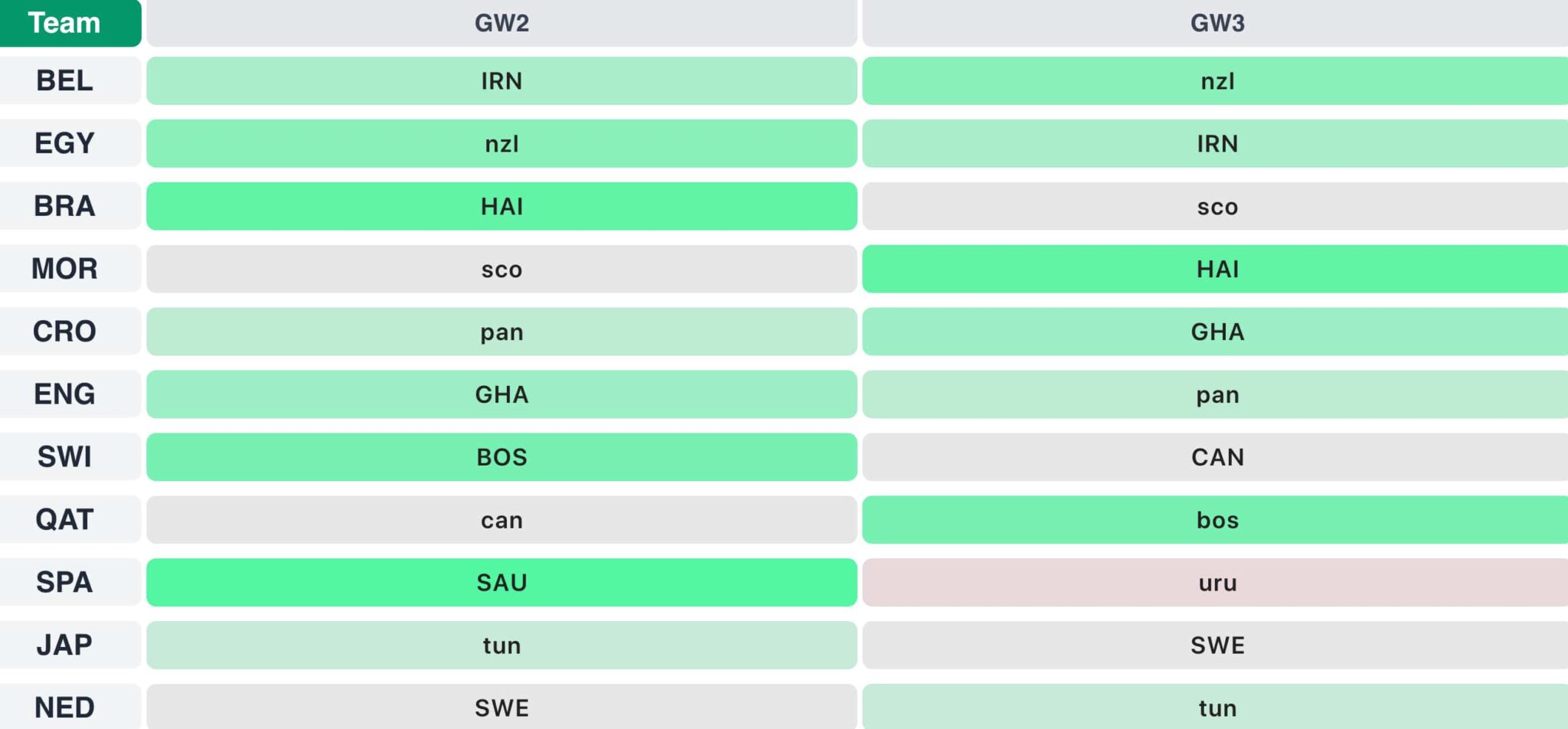
In this section, we have compiled a schedule of matches that teams started in Rounds 2 and 3.
This is primarily to help Fantasy managers who use Wildcard Round 2 strategies.
BelgiumThe match schedule immediately changed, with Rudi Garcia’s men set to face Iran and New Zealand. The Kiwis are the lowest-ranked nation in the World Cup (85th) and lost 4-0 to Haiti in a recent friendly.
Hossam Hassan’s Egypt face the same opponents in reverse order, but context is always key when looking at the ticker: even against New Zealand, their win probability is still only 57.8%.
Brazil have some decent matches on the horizon. Haiti is one of their opponents, which is why the possession rate of Vinicius Junior and Raphinha ($8.2 million) is expected to increase rapidly as we approach the upcoming deadline.
Likewise, Round 2 could be a great time to move on English assets, with Ghana ranked 73rd in the world after a series of poor results.
Other countries interested in Wildcard Round 2 are Morocco, Croatia, Switzerland, Spanish and it Dutch.
Can Japan maybe also provide some Scout Bonus options? They have beaten England and Brazil since securing World Cup qualification, and could be considered the dark horses of this summer.
Full-back Ritsu Doan ($5.1 million), who is more of a winger at club level, registered 18 attack returns for Freiburg last season, while no Japanese player bettered expected goal involvement (xGI) in qualifying. Takefusa Kubo ($7.0 million) and Ayase Ueda ($7.0 million) are options worth further consideration.

PakarPBN
A Private Blog Network (PBN) is a collection of websites that are controlled by a single individual or organization and used primarily to build backlinks to a “money site” in order to influence its ranking in search engines such as Google. The core idea behind a PBN is based on the importance of backlinks in Google’s ranking algorithm. Since Google views backlinks as signals of authority and trust, some website owners attempt to artificially create these signals through a controlled network of sites.
In a typical PBN setup, the owner acquires expired or aged domains that already have existing authority, backlinks, and history. These domains are rebuilt with new content and hosted separately, often using different IP addresses, hosting providers, themes, and ownership details to make them appear unrelated. Within the content published on these sites, links are strategically placed that point to the main website the owner wants to rank higher. By doing this, the owner attempts to pass link equity (also known as “link juice”) from the PBN sites to the target website.
The purpose of a PBN is to give the impression that the target website is naturally earning links from multiple independent sources. If done effectively, this can temporarily improve keyword rankings, increase organic visibility, and drive more traffic from search results.