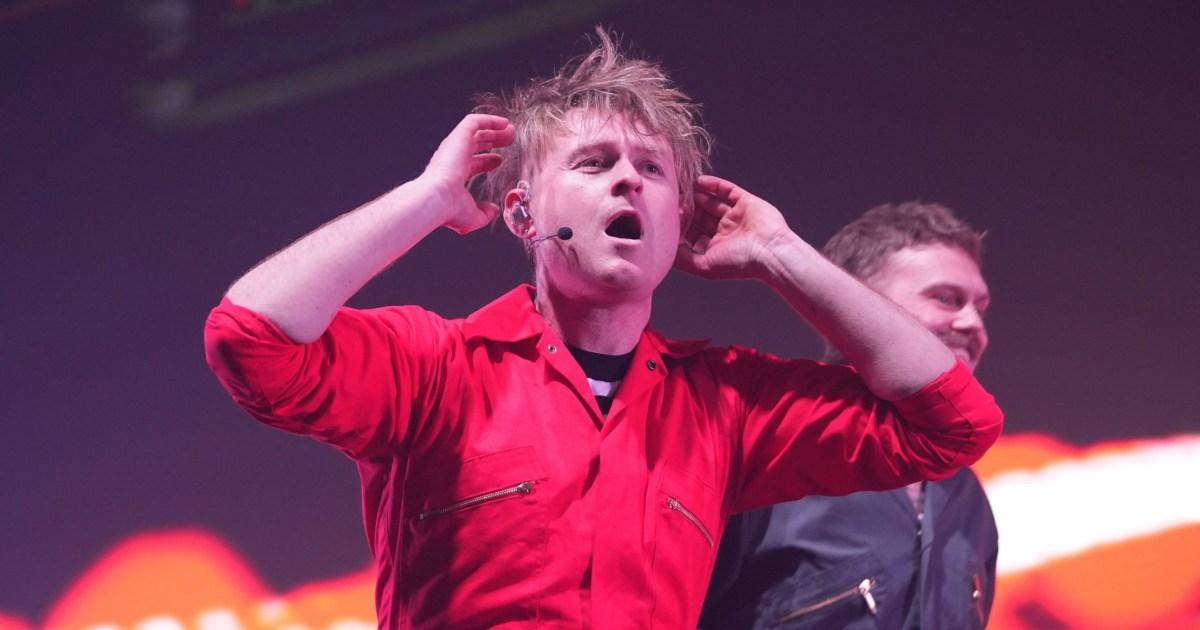
Eurovision fans are increasingly concerned about how Britain will perform at this year’s contest after a clip of the artist’s performance was released.
Take a look Mum No Computer – real name Sam Battle – is this year’s UK representative and is in Vienna, ready to take to the stage to battle (pun not intended) for top spot against the rest of the country with the song, Eins, Zwei, Drei.
With the Grand Final just over a week away, the general public has been given a glimpse of what a live version of the techno-pop song might look like.
And the 37-year-old music artist leans fully into the electronic aesthetic with a set design of wire button machines and a group of dancers with furry computers on their heads, with the ‘experimental’ singer giving off a mad scientist look as he pulls various fake levers.
Of course, apart from the rare exception in 2022 when British entrant Sam Ryder finished second with Space Man, it has been decades since our little island made it to the final rankings so well.
England are used to being in the bottom position. In 2025, girl group Remember Monday placed 19th out of 26 with 88 points from professional judges and zero points from public votes.
However, after seeing Look Mum No Computer’s offering, viewers fear this could be the worst year yet.
‘So the zero point streak continues…’ X user ka_morian0121 shared.
‘UK receives NIL POINTS,’ predicts M.
‘It’s safe to say, we didn’t win it this year,’ Joe shared.
‘This is a complete mess. “Nil pwahhhhh,” said J.
‘Let’s prepare for last place again!’ S wailed. ‘Another year at the bottom of the leaderboard,’ echoed Lily W.
‘A serious contender… for last place,’ Crashgrana declared brutally.
Some people have come to Look Mum No Computer’s defence, trying to give it the benefit of the doubt.
‘I like the song. Not interested in that [at] I used to but now I love it,’ added StuartIbertson.
‘It’s a shame the “machine” looks fake and I did expect more from England. Still, it’s a unique and catchy song, but I think it’s in the bottom five again for us,” wrote DougnutDoney.

‘It makes you wonder why anything new gets so much negativity, be it a song, a new program, whatever!’ Debt is reflected.
‘The UK actually did something interesting for their Eurovision entry,’ wrote LDN48.
This is the first song in this 70-year-old contest where the English song will not be sung entirely in English, making it stand out. And it’s all about the mundanity of nine to five.
Speaking about the song when it was first released in March, he said: ‘It means 123, in German, for people who don’t know it.
‘It felt right to write a song that covers a lot of European things – it’s all about going on holiday, and the way I feel about eating pizza, maybe in Italy.
‘I’m bored of eating this [jam] roly poly, which I love to eat most of the year, but I just wanted a little break from it.’
As proceedings begin in Vienna, the contest is also set to face controversy after several countries announced they were boycotting this year’s competition due to Israel’s entry – including Big Five nation Spain.
Just this week, Israeli broadcaster KAN received an official warning for violating competition rules over their participant’s promotional video.
Have a story?
If you’ve got a celebrity story, video or pictures get in touch with the Metro.co.uk entertainment team by emailing us [email protected], calling 020 3615 2145 or by visiting our Submit Stuff page – we’d love to hear from you.
MORE: Eurovision on ‘high alert’ after threats from ISIS and Iran
MORE: Boy George set to ‘give nothing away’ during critical Eurovision performance
MORE: The Eurovision favorites have a secret weapon that no other act can rely on
PakarPBN
A Private Blog Network (PBN) is a collection of websites that are controlled by a single individual or organization and used primarily to build backlinks to a “money site” in order to influence its ranking in search engines such as Google. The core idea behind a PBN is based on the importance of backlinks in Google’s ranking algorithm. Since Google views backlinks as signals of authority and trust, some website owners attempt to artificially create these signals through a controlled network of sites.
In a typical PBN setup, the owner acquires expired or aged domains that already have existing authority, backlinks, and history. These domains are rebuilt with new content and hosted separately, often using different IP addresses, hosting providers, themes, and ownership details to make them appear unrelated. Within the content published on these sites, links are strategically placed that point to the main website the owner wants to rank higher. By doing this, the owner attempts to pass link equity (also known as “link juice”) from the PBN sites to the target website.
The purpose of a PBN is to give the impression that the target website is naturally earning links from multiple independent sources. If done effectively, this can temporarily improve keyword rankings, increase organic visibility, and drive more traffic from search results.